Hinge Box
Hinge pattern
How the living hinge is cut: the pattern, the cut style and the size of every slit and bar.
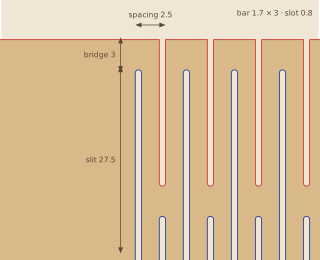
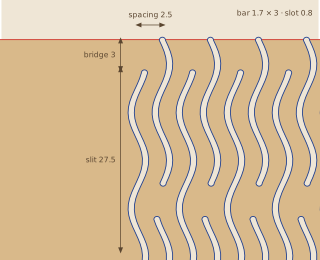
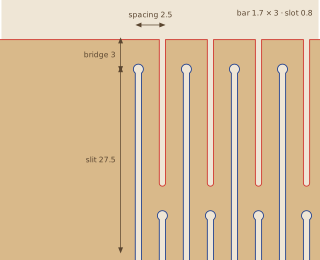
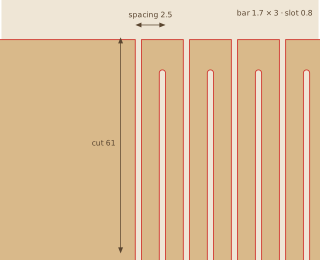
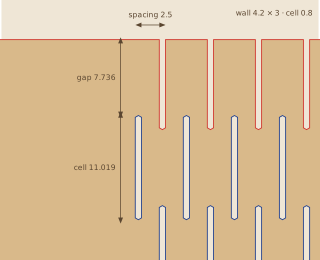
A living hinge is a field of parallel slits that lets a stiff sheet bend. Each bar between the slits twists a little, and hundreds of small twists add up to a curve.
Patterns
- Straight: the classic lattice. Strong and predictable; the best default.
- Wave: every cut is a parallel copy of the same wave, so bars keep one width. A little softer than Straight, and it hides the slits.
- Relief: Straight with a small round hole at every cut end, which spreads stress and resists cracking in brittle sheet such as MDF.
- Serpentine: cuts run in from alternate edges, turning the wall into a spring. Bends very tightly but stretches, so glue the wall.
- Honeycomb: columns of hexagon cells, each column nested half a cell down from the last. Cell width sets the hexagons and Spacing the distance between columns; the walls between them are what bends. Stiffer than Straight, so it suits large corner radii: auto-fit or the radius fix finds a pair that bends.
Cut style
- Slots: each cut is a round-ended slot of set width. Best for thick or stiff sheet.
- Single line: each cut is one laser line, as wide as the kerf. Best for thin sheet and card.
Auto-fit
Auto-fit picks the stiffest hinge that still reaches your corner radius with a 30% safety margin. Stiffer means fewer cuts, less charring and a stronger wall.
Options
- Slot width0.2 mm or more · step 0.05 mm
- The width of each hinge cut when Cut style is Slots. Wider slots bend further before the cuts close up, but leave thinner bars.
- Slit3 mm or more · step 0.5 mm
- The length of each hinge cut. Longer slits make longer torsion bars, so the wall bends more easily and more tightly.
- Bridge0.5 mm or more · step 0.25 mm
- The uncut material between two slits in a column. Smaller bridges bend more easily but are more fragile.
- Spacing0.5 mm or more · step 0.05 mm
- The distance between hinge columns. Tighter spacing bends further but leaves thinner bars that can char or snap.
- Overrun0 mm or more · step 0.5 mm
- How far the hinge carries on past each corner, so the bend blends into the flat sides instead of kinking.
- Stretch %0 to 8 · step 0.5
- Shortens each hinge zone by this percentage, because the cuts open a little as the wall bends. Leave it at 0 and raise it only if a test wall comes out too long.