Clock
Clock generator
The Clock generator draws a wall or desk clock to fit a standard quartz movement: the face, hour markers, hands with the right holes, a hanger and an optional stand. Faces come round, square, polygonal, sunburst, gear, scalloped, flower, heart, cloud or any outline you paste.
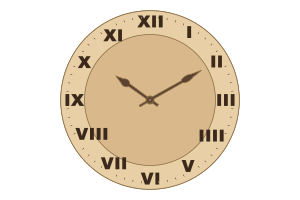
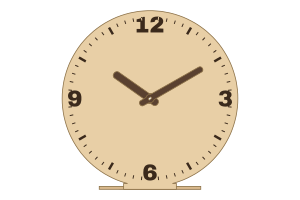
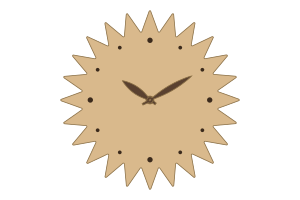
Buy the movement first and check its shaft length: the face must be no thicker at the centre than the thread can clamp. Measure the hand holes if your movement's hands are not the usual size and enter them under Movement → Custom sizes.
Face
The clock's outline and how many layers it is cut from.
Markers
The hour marks: ticks, dots or numerals, engraved or cut through.
Text on the dial
A line of text bent along the dial inside the markers, such as a name, a date or a motto.
Hands
The hour and minute hands, cut with holes that press onto the movement.
Movement
The quartz clock movement the face and hands are cut for.
Hanging
How the clock hangs on the wall or stands on a desk.
Presets
- Wall clock: Roman numerals on a raised ring.
- Desk clock with stand: Slot-in stand, no glue needed.
- Sunburst: Mid-century rays, dot markers.
- Minimal: Twelve bold ticks, slim hands.
- Gear clock: Cut-through ticks show the back plate.
- Square, three layers: Back, ring and centre disc.
- Hexagon, kids: Big rounded numbers.
- Station clock: Numerals follow the dial, name along the top.
- Flower clock: Eight petals, four big numbers.
- Heart clock: Dots and pointer hands, a gift clock.
- Cloud, nursery: Soft cloud outline, four big numbers.
- Modern Roman: IV instead of IIII, numerals follow the dial.
- Lounge sunburst: Large sunburst with baton hands for a lobby.
- Kitchen scallop: Scalloped kitchen clock with dots and leaf hands.
- Studio hexagon: Six-sided studio clock with mixed markers.
- Bloom numerals: Flower face with classic numerals for a cafe.
Material, layers and sheet
Set your material's thickness and kerf first: the kerf is applied once to every outline and hole. Engraving is filled on its own layer, which the SVG puts first so it runs before the cuts.
Options
Face
- Face shapeRound, Square, Polygon, Sunburst, Gear, Scalloped, Flower, Heart, Cloud, Custom
- The outline of the clock face; Custom takes the path data of any closed outline.
- Size80 to 1200 mm · step 5 mm
- Width of the face across its widest point (corners or ray tips).
- Sides3 to 24 · step 1
- Number of sides of the polygon face.
- Corner radius0 to 120 mm · step 1 mm
- Rounds the corners of the face; 0 keeps them sharp.
- Rays6 to 72 · step 1
- Number of rays, teeth, scallops or petals around the edge.
- Ray depth2 to 200 mm · step 1 mm
- How far the rays, teeth or scallops reach in from the outer edge; for a flower, the petal radius.
- Custom outlinetext
- SVG path data (the d attribute) of a closed outline; it is scaled to the face size.
- LayersSingle, Ring on back, Ring and centre
- Single cuts the face from one sheet; Ring adds a raised ring on a back plate; Stack adds a centre disc as well.
- Ring width5 to 200 mm · step 1 mm
- Width of the raised ring, measured in from the outer edge.
- Centre disc20 to 400 mm · step 1 mm
- Diameter of the raised disc in the middle of the face.
Markers
- MarkersNumerals, Numerals + ticks, Ticks, Dots, None
- What marks the hours: numerals, ticks, dots, or numerals at 12, 3, 6 and 9 with ticks between.
- NumeralsRoman (IIII), Roman (IV), Arabic
- Arabic (1–12) or Roman (I–XII, with the clockmaker's IIII or the modern IV) numerals.
- Only 12, 3, 6 and 9on or off
- Shows four numerals and ticks for the other hours.
- Fontany Letters font
- The typeface of the numerals (the same fonts as Letters).
- Numeral height4 to 200 mm · step 1 mm
- Cap height of the numerals.
- Edge gap0 to 200 mm · step 1 mm
- Gap between the edge of the face and the outer end of the markers.
- Tick length2 to 100 mm · step 1 mm
- Length of the hour ticks; minute ticks are a little under half as long.
- Tick width0.5 to 30 mm · step 0.5 mm
- Width of the hour ticks; the ticks at 12, 3, 6 and 9 are wider.
- Dot size2 to 60 mm · step 0.5 mm
- Diameter of the hour dots; the dots at 12, 3, 6 and 9 are larger.
- Minute tickson or off
- Adds a short tick for every minute between the hours.
- Cut throughon or off
- Cuts the markers out instead of engraving them, so the layer behind shows through.
- Follow the dialon or off
- Turns each numeral so its top points outward, as on classic dials, instead of standing upright.
Text on the dial
- Texttext
- The words bent along the dial; leave empty for none.
- PositionTop, Bottom
- Along the top the text reads clockwise with the letters standing outward; along the bottom it reads the other way, so both read left to right.
- Fontany Letters font
- Typeface of the text (the same fonts as Letters).
- Text height3 to 80 mm · step 0.5 mm
- Cap height of the text.
- Gap to markers0 to 100 mm · step 0.5 mm
- Space between the markers and the text; a larger gap moves the text toward the centre.
Hands
- HandsSpade, Baton, Pointer, Leaf, Arrow, None
- The hand shape; None leaves them out if you use the hands that came with the movement.
- Minute hand20 to 400 mm · step 1 mm
- Length from the centre of the shaft to the tip of the minute hand.
- Hour hand15 to 300 mm · step 1 mm
- Length from the centre of the shaft to the tip of the hour hand.
- Width2 to 60 mm · step 0.5 mm
- Widest part of the minute hand; the hour hand is a quarter wider.
- Tail0 to 120 mm · step 1 mm
- Counterweight behind the centre, which helps the movement turn long hands.
Movement
- MovementStandard, short shaft (face up to 5 mm), Standard, medium shaft (face up to 8 mm), Standard, long shaft (face up to 13 mm), Custom sizes
- Standard quartz movements differ in shaft length, which limits how thick the face can be at the centre.
- Shaft hole3 to 20 mm · step 0.1 mm
- Hole through the face for the movement's threaded shaft.
- Hour hand hole2 to 12 mm · step 0.1 mm
- Round hole in the hour hand; measure the movement's hour pipe.
- Minute hole width1 to 10 mm · step 0.1 mm
- Minute hand hole, measured across its round sides.
- Minute hole flats1 to 10 mm · step 0.1 mm
- Minute hand hole, measured across its two flat sides.
- Thickest face1 to 30 mm · step 0.5 mm
- The thickest face the shaft's thread can clamp.
Hanging
- HangerKeyhole, Hole at the top, None
- A keyhole slot on the back plate, a small hole near the top, or none (most movements have a hook).
- Desk standon or off
- Adds a base with a slot; a tab under the face pushes into it.